Overview

The field of science and society engagement continues to grow and evolve globally. At AIMS South Africa, this research area supports the work of the AIMS House of Science, which bridges the mathematical sciences, public engagement, and social transformation.

Our research strengthens the academic scholarship, global visibility, and impact of AIMS’ science communication and public engagement programmes. It also contributes to advancing the science communication and public engagement agenda across Africa.

Through interdisciplinary collaboration drawing on fields such as Education, Science Communication, Sociology of Science, History of Science and Technology, Mathematical Sciences, Gender Studies, and Science and Technology Studies, we aim to advance meaningful science - society dialogue and engagement, strengthen research outputs and data-driven insights and contribute to Africa’s evolving Afrocentric paradigm in science communication.

This work supports a broader vision of inclusive, culturally relevant, and socially responsive science communication in Africa.

banner image

Global Engagement and Collaboration

Our research is strengthened through local and international collaborations and networking opportunities, including participation in leading international science communication conferences.

These engagements provide opportunities to:

  • Present research and share best practices from AIMS South Africa
  • Exchange knowledge with science communication practitioners worldwide
  • Access mentorship and collaborative partnerships
  • Contribute to and publish in international science communication journals

Research Focus Areas

Our research sits within the broader themes of Science and Society, Diversity, Equity, and Inclusion, with particular attention to:

  • Science communication and public engagement in African contexts
  • Gender inclusion and transformation in STEM in higher education
  • Knowledge management, including data synthesis, research evaluation, and programme impact analysis
  • Ethics, equity, and inclusivity in science, technology, innovation, and communication
  • The intersections between science, culture, and society

Latest Publications

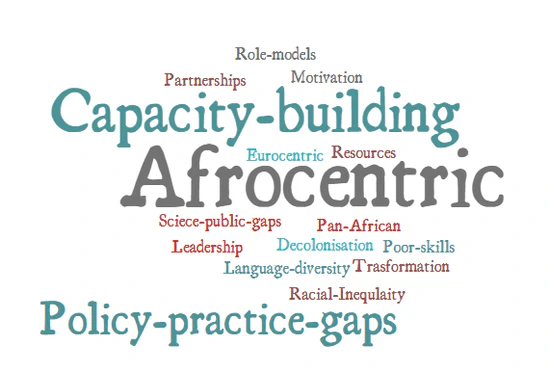
Building Capacity for Science Communication in South Africa: Afrocentric Perspectives from Mathematical Scientists

Bookchapter in Race and Sociocultural Inclusion in Science Communication: Innovation, Decolonisation, and Transformation, Bristol University Press.

Abstract: Globally, the past decade has seen the proliferation of the science communication agenda across a range of platforms. This book chapter argues that gaps exist between the South African government’s well-developed policy positions and the practical implementation of its scientists’ imperative to deliver, through meaningfully resourced mechanisms, a viable, sustainable, and impactful science communication agenda. The chapter concludes by elaborating how the capacity-building, Afrocentric programme ‘Africa Scientifique: Leadership, Knowledge & Skills for Science Communication’, delivered annually since 2020 at AIMS South Africa and in partnership with African Gong, has demonstrated the potential to address the aforementioned gaps and challenges

This book received the ICOM-CIMUSET Special Recognition Award (September 2024) for its contribution to advancing diversity, equity, and inclusion in global science communication.

Why scientists agree to participate in science festivals: evidence from South Africa

Published in International Journal of Science Education

Abstract: The recent decade has seen the proliferation of the ‘public engagement’ agenda and the calls for actions from various governments and scientific institutions for scientists to engage with the broader society across a range of platforms as reflected in the science-policy frameworks, both in Africa and globally. For the Department of Science and Innovation Science Engagement Strategy and the 2019 White Paper on Science, Technology and Innovation, public science engagement in South Africa is positioned as a mandatory activity for scientists and organisations that receive public funding. But what are the factors that motivate and/or deter scientists’ interest and willingness to participate in Science Engagement activities such as science festivals? This paper on provides practical insights into country-specific motivations for scientists to engage with a diverse range of audience in South Africa’s annual national science festival, Scifest Africa.Abstract

Get Involved

Are you passionate about advancing science-society engagement, strengthening research outputs and data-driven insights, and contributing to Africa’s evolving Afrocentric science communication paradigm?

We welcome collaboration with researchers, academics, and practitioners interested in advancing research on public engagement, transformation, and inclusive science communication in Africa.

For more information or to get involved, please contact: houseofscience@aims.ac.za"

Muizenberg