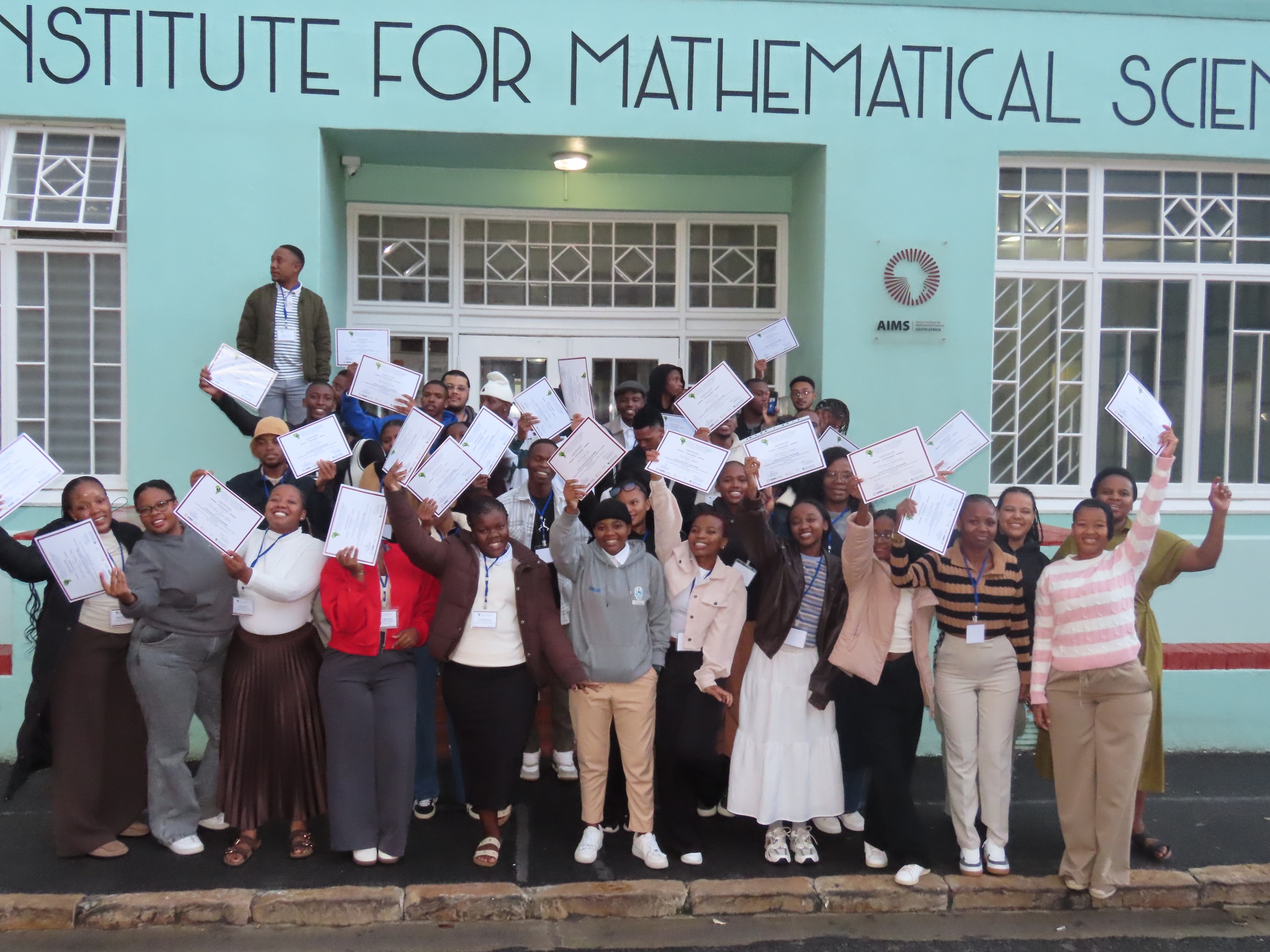
Building Capacity for CPUT, SPU, UFH & UNIZULU Mathematical Sciences Scholars in Transformative Leadership and Impactful Public Science Communication
From 15 - 17 April 2026, forty Honours and Master’s students, together with five Academic Leads in the mathematical sciences from Cape Peninsula University of Technology (CPUT), University of Fort Hare (UFH), Sol Plaatje University (SPU), and University of Zululand (UNIZULU), participated in Phase 2 of the 2026 Africa Scientifique Programme at AIMS South Africa, delivered in partnership with African Gong.
The annual three-phase programme aims to strengthen the capacity of young and emerging African researchers in leadership, science communication, and public engagement. Phase 1, completed in March 2026, introduced participants to the strategic, historical, global, and contemporary dimensions of science communication, while Phase 2 provided intensive hands-on engagement with public science communication and engagement practices in preparation for Phase 3 – a six-month mentored science communication outreach and project implementation phase.
Designed as an intensive, highly interactive, hands-on, minds-on three-day workshop, the programme empowered participants to leverage science communication skills to advance leadership, career growth, employability, and impact across academia, industry, and broader society.

|

|

|
Opening remarks were delivered by Prof Karin Therese Howell, Executive Director of AIMS South Africa; Dr Akanimo Odon, CEO of Envirofly Consulting UK Limited and Africa Strategy Adviser at Lancaster University in the United Kingdom; Dr Elizabeth Rasekoala, President of African Gong; and Dr Rejoyce Gavhi-Molefe, Manager of AIMS South Africa House of Science.
Welcoming participants, Prof Howell described the workshop as part of AIMS South Africa’s broader mission to empower young scientists to communicate their work “clearly, confidently and effectively.” She emphasised that:
“The ability to share scientific ideas beyond the laboratory and beyond the walls of the classroom are just as important as the research itself, especially in a rapidly changing world shaped by artificial intelligence and innovation.” – Prof Howell
In his inspiring keynote address, Dr Akanimo Odon, an international expert in business and strategy development and cross-border education partnerships, challenged young African researchers to rethink the purpose of research and publication, asking: “Why are you publishing? … Can you also publish having impact?” He encouraged participants to see Africa’s challenges not as limitations, but as opportunities for innovation and creativity, stating:
“Africa doesn’t have a problem with problems… everywhere you go within your area of research, if you think critically and carefully, there are always problems to solve.” – Dr Odon
A central theme of his keynote was the importance of intentional science communication and collaboration beyond academia. Dr Odon emphasized that researchers should engage communities, policymakers, and industry stakeholders from the beginning of the research process rather than as an afterthought.
“Science communication has to be co-created at the point of developing the framework of research, and researchers must get out of their bubble to go meet other folks in other bubbles.”
Dr Odon also highlighted the need for African researchers to increase their professional visibility and build strategic partnerships through networking and digital platforms such as LinkedIn. He urged participants to intentionally communicate their work to wider audiences, noting that “LinkedIn provides a way to communicate scientific work in a non-scientific way to a non-scientific audience.” He concluded his address by encouraging young academics to pursue interdisciplinary and international collaborations and reminding them about their role as young scientists in transforming the continent:
“You are the ones who will change the continent in terms of the narrative… when you are publishing a paper, why can’t you also publish for impact?”, he added

|

|

|
Over the three days, participants engaged in transformative, informative, mindful, and highly interactive workshops, networking opportunities, and practical activities facilitated by dynamic science communication experts and scientists – Dr Elizabeth Rasekoala, Dr Rejoyce Gavhi-Molefe, Prof. Nox Makunga, Medical Plant Biotechnology Expert: Stellenbosch University and Dr Michael Kateregga, Team Lead of the Data Science Division: Morae Global, Cape Town.
Mathematical scientists and Africa Scientifique alumni currently pursuing careers in academia and industry also contributed as mentors and role models, helping to create a transformative and inclusive learning environment.
The workshop featured rich, diverse sessions that framed globally inclusive yet Afrocentric discourses, narratives, and good practice developments aimed at transforming the participants’ understanding and enhancing their commitment to equity, ethics, and hands-on public engagement actions in the future. Inherent in these good practices was solidarity with African publics, foregrounding African local and Indigenous languages for science communication and public engagement across the continent, contextualised within socio-cultural dimensions, including gender inclusion.
Workshop Outcomes and Participants’ Testimonials
Participants described the programme as transformative, empowering, and life-changing.
“Over three intensive days, I learned from an inspiring lineup of experts – Professors, PhDs, Lead Data Scientists, Junior Data Scientists, and Science Communication specialists.
What I gained:
🧠 Leadership, employability & career progression strategies
📢 Research dissemination & presentation skills
🌍 Gender & socio-cultural inclusion in science communication
✍️ Practical exercises that turned theory into actionKey skills I developed:
-Articulating technical ideas quickly and clearly
-Pacing myself while presenting to keep audiences engaged
-Tailoring my message for the one’s understanding (not just for experts)
-Critical thinking & applying science to real community problems
-Public engagement, collaboration, and sharing ideas with impactAs a future Data Scientist, these skills are just as critical as coding and modelling…”
— Aphiwe Rasmeni (CPUT)
“This capacity building programme for African researchers and science communicators… My biggest takeaway are learning how to communicate, not just talk.”
— Ignatia Lesego Khabo (UFH)
“Another achievement attained from African Scientifique… I never knew how to communicate my Science to any civilian until this workshop taught me.”
— Zazi (Muzikayise) Biyela (SPU)
“This experience strengthened my ability to communicate complex quantitative concepts…”
— Thuto Treasure Nkosi (UNIZULU)
What’s next? From Theory to Practice - Beyond the Lecture Halls!
Over the next six months (May - October 2026), participants will apply the science communication and leadership skills gained during the 3-day intensive workshop to address real societal challenges by leveraging mathematical science knowledge and research within their own communities, with support from facilitated mentoring and guidance.
Together, we are breaking barriers, advancing the mathematical sciences to be more accessible, inclusive, and Afrocentric, and building a strong, critical mass of African science communicators.
